By Edward Spannaus
It is well-known around here that the Ketoctin Baptist Church was a stronghold of revolutionary fervor during the American Revolution. The Guide to Loudoun in the American Revolution, published by the Loudoun County 250 Committee, reports:
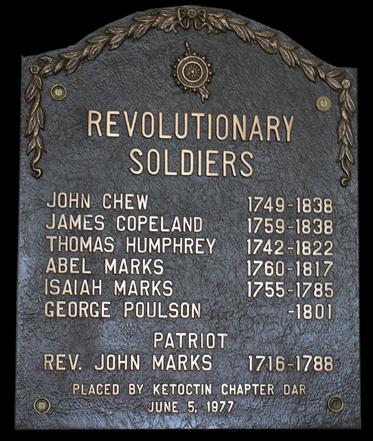
It was rebellious Baptists who became the fighting backbone of the Revolution in Loudoun. One Baptist preacher, Reverend John Marks of Ketoctin Church northwest of what is now Purcellville, was bringing in as many as 500 congregants to his outdoor services where he preached avid support for the patriot cause. His son, Captain Isaiah Marks, was inspired to join the Continental Army, becoming one of the heroes of the Revolution. He is buried there in the Ketoctin Churchyard … there is a well-marked grave.
Joseph V. Nichols’ 1938 Legends of Loudoun Valley tells how Rev. Marks held many meetings in his log church instructing his parishioners, and also community members, of their rights as British subjects. The meetings grew so large that even standing room in the church was scarce. Nichols also reports:
A delegation of German settlers from what is now Lovettsville district attended one of these meetings. Their leader’s English was so broken that little of what he said could be understood, but his manner, tone of voice and general expression showed very plainly where his sympathies were.
On June 7 of this year, the Ketoctin Baptist Church held an event celebrating its 275th Anniversary (1751-2026), as well as the Nation’s 250th Anniversary.
That was one of the inspirations for this article.
Persecution of the Baptists
The other was a panel discussion on “Before Religious Freedom: Faith Traditions in Revolutionary Virginia,” which was held on July 17 at a historic Anglican/Episcopal church near Culpeper, Virginia. The panel featured representatives of the Anglican/Episcopalian, Lutheran, and Baptist traditions, and was part of the Annual Historic Germanna conference.[i]
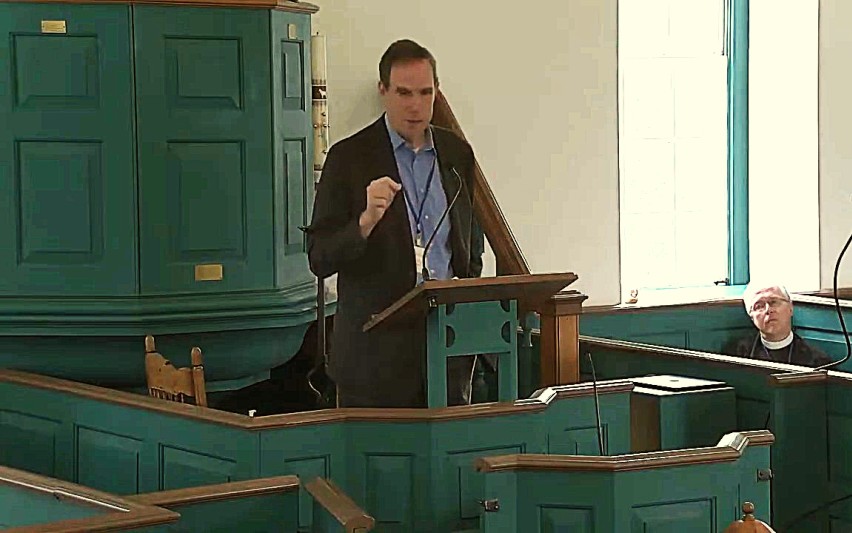
As part of this discussion, Pastor Dan Carlton of the Culpeper Baptist Church took up the history of the brutal persecution of the Baptists in Virginia by the Anglican Establishment. Baptists preached to both enslaved and free blacks, in camp meetings which were often broken up by men on horseback (Anglican Vestrymen and others) riding through the crowds.
Eleven Baptist preachers were jailed just in Culpeper alone in the 1768-1770 years. Nearly half of all the Baptist preachers in Virginia were imprisoned at one time or another. The best-known was James Ireland,[ii] jailed in 1769-1770, who called the county jail, “My Palace in Culpeper.” At one point, his enemies tried to blow up his basement jail cell; they tried to poison him, and at another time, they urinated in his face as he was preaching through the barred window of his cell. (Decades later, with a wonderful sense of irony, the Culpeper Baptists built their church on the site of the old jail.)
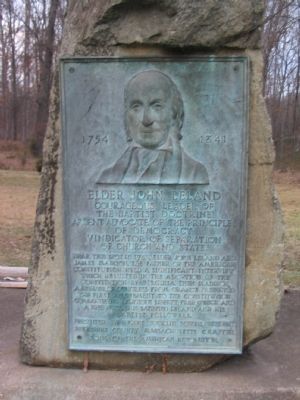
Inscription: Elder John Leland- Courageous leader of the Baptist Doctrine; Ardent advocate of the principles of democracy; Vindicator of separation of church and state.
Near this spot in 1788, elder John Leland and James Madison, the father of the American Constitution, held a significant interview which resulted in the adoption of the Constitution by Virginia. Then Madison, a member of Congress from Orange, presented the First Amendment to the Constitution guaranteeing religious liberty, free speech, and a free press. This satisfied Leland and his Baptist followers.
As a consequence of this persecution, Virginia Baptists became the most fervent and outspoken advocates of religious freedom, not only opposing the favored status of the Established (Anglican/Episcopal) Church, but arguing that government should not favor any particular religion, and that all religions, Protestants and Catholics, Jews and Muslims (“Turks”), must be equally protected in their right to worship freely.
Pastor Carlton told the story of how John Leland, a Baptist pastor in Culpeper (1776-1778) and then in Orange County, directly influenced the inclusion of religious freedom in the United States Constitution. During the 1788 election campaigns –first for delegate to the Virginia ratification convention, and then for the First U.S. Congress — James Madison asked to meet with Leland, as Madison was anxious to prevent Leland from opposing him in the elections, and he was seeking Baptist support for the new proposed Constitution. As the condition for obtaining the support of the Baptists, Leland insisted on absolute religious freedom – which indeed was incorporated into the very first amendment to the United States Constitution, ratified in 1791.
Ketoctin Baptist
How does Loudoun’s Ketoctin Baptist Church fit into this picture?
Ketoctin Church was not subject to the same degree and intensity of persecution as was the case for Baptists in other parts of Virginia, although one Baptist, Samuel Harris, a roving Baptist “apostle” who had been harassed in many locations including Culpeper and Orange County, was also locked up in jail in Loudoun “for some time.” (Harris was a more militant “Separatist Baptist,” while the Ketoctin church was made up of “Regular Baptists.”)
Some sources attributed this lessened degree of persecution to the fact that the Established (Anglican) Church was not dominant in western Loudoun County.
A history of Ketoctin Church delivered in 1906 by Rev. J.H. James states that Ketoctin is the oldest Baptist church in Virginia. There were earlier ones – 1714 in Isle of Wight County, and 1743 in Mill Creek, Berkeley County (now West Virginia) – but since those churches have long ago gone out of existence, Rev. James reckoned Ketoctin to be the oldest Baptist church still in existence.
From the standpoint of those of us in Lovettsville/The German Settlement – which was settled by German immigrants from Pennsylvania and Maryland — it is notable that the first three ministers at Ketoctin also all came from Pennsylvania and Maryland, as did many of its early members.
According to Rev. James, the first known group were migrant Marylanders who had gone to Mill Creek, in Berkley County in the Shenandoah Valley. Their pastor was John Gerrard. In 1755, fleeing the French-Indian War, they escaped into what is now Loudoun County, settling on Ketoctin [Catoctin] Creek, and building the first church on the site in 1756.
John Marks succeeded Garrard in 1760, when Garrard returned to the Valley. Marks came to Loudoun from Montgomery County, Pennsylvania, and he remained at Ketoctin throughout the Revolutionary War, for a ministry of 27 years. Five of his sons served as soldiers during the Revolutionary War.
Official Baptist sources[iii] date Ketoctin’s founding earlier, to 1751. The first members were Baptists of Scotch Irish and Welsh extraction. They were soon joined by John Thomas, who had emigrated from Wales to Philadelphia, and quickly became a frontier minister. John Thomas is thus properly considered Ketoctin’s first pastor, and was succeeded by John Garrard and the refugees from the Valley, and then by John Marks, who had been a member of John Thomas’s home church in Montgomery County, Pennsylvania.
In 1766, Ketoctin Church and three other “Regular” Baptist churches in scattered counties in the Piedmont and the Valley withdrew from the Philadelphia Association and formed the “Ketocton Association.” By 1771 the split between Virginia “Regulars” and “Separates” had hardened, and by 1776, the Ketocton Association had over twenty member churches.
Founded shortly after Ketoctin church, were New Valley Baptist Church (1767), near Lucketts in northern Loudoun County, and Little River Baptist Church (1768), in southeast Loudoun. Both were members of the Ketocton Association.
By the end of the Revolutionary War, apparently at the initiative of the Ketocton Association, the Regulars and the Separatists were cooperating in the fight for religious freedom. Although Virginia Baptists had won two of their immediate objectives – the right to worship freely and the end of taxation for religious purposes – in 1780 the Regulars and Separates sent a joint petition to the General Assembly demanding that the Anglican/Episcopalian parish vestries cease carrying out any civic activities, and that Baptist ministers be allowed to conduct marriage ceremonies.
In 1785, Patrick Henry had proposed a compromise bill, which would have levied a tax “for Teachers of the Christian Religion.” Virginia Baptists opposed the bill, fearing it could lead to a new established religion. The Baptists explained that it was “repugnant to the spirit of the Gospel for the Legislature thus to proceed in matters of religion; that no human laws ought to be established for this purpose; but that every person ought to be entirely free in respect to matters of religion.”
In 1786 the General Assembly not only rejected Patrick Henry’s proposal, but adopted Thomas Jefferson’s Act for Establishing Religious Freedom – a very radical measure for the time.
The Ketoctin Church’s role in the fight for religion freedom goes back much earlier. In 1772, a bill was introduced in the House of Burgesses by the Anglican-dominated Committee for Religion, which required all dissenters to register their meeting houses with the county clerk; prohibited any preaching elsewhere; stated that the doors of meeting house could not be fastened during services; and barred the presence or baptism of slaves without their owners’ permission.
The Ketocton Association met in 1773, and in 1774 it drafted a petition opposing this bill, which was presented to the House of Burgesses. And as a constituent group of the broader Virginia Baptist General Association, and then of the Baptist General Committee, the Ketoctin Church and the Ketocton Association continued to oppose any and all measures which would restrict religious freedom, or provide for government sponsorship of any religious body or activity. The fight to implement Virginia’s religion freedom law continued after 1786, until 1794, when the glebes (property granted to the Established Church) were abolished and reverted to the State of Virginia.
But meanwhile, Ketoctin Church, and the Ketocton Association in which the Loudoun church played a leading role, were also active in the effort to ensure religious liberty and the separation of church and state in the new federal government. In 1788, after the federal Constitutional Convention, the Baptist General Committee decided that the proposed Constitution did not make sufficient provision for the enjoyment of religious liberty. John Leland, one of its leaders, announced as a candidate for the Virginia Ratification Convention, in opposition to the Constitution and to Madison, who was also a candidate. After the meeting cited above, where Madison pledged to support full religious freedom, Leland came out in support of Madison and for ratification. Baptist support elected Madison to the Convention, and later in the year to the new U.S. Congress, in which Madison introduced the 1st Amendment, which ensured religious liberty and the principle of the separation of religion and civil government.
In August 1789, the Virginia Baptists sent a long letter to the new President, George Washington, congratulating him on his appointment as President, and urging his full support for liberty of conscience, and asking for his opposition to any form of religious oppression.
In his reply to the Baptists, Washington assured them that “no one would be more zealous than myself to establish effectual barriers against the horrors of spiritual tyranny, and every species of religious persecution.” And he reminded them that he had often expressed his sentiments that every man “ought to be protected in worshipping the Deity according to the dictates of his own conscience.”
Thomas Jefferson and the Ketocton Baptist Association
The Ketocton Baptists did not just sit back and relax after the ratification of the Constitution and the First Amendment.
Although I’ve been unable so far to locate it, the Ketocton Baptist Association sent a letter to Thomas Jefferson upon his retirement in 1808. Jefferson responded on October 18, 1808, in a letter which stated in part:
To the members of the Ketocton Baptist Association.
I received with great pleasure the affectionate address of the Ketocton Baptist
Association, and am sensible how much I am indebted to the kind dispositions
which dictated it.In our early struggles for liberty, religious freedom could not fail to become a
primary object. All men felt the right, and a just animation to obtain it was excited
in all. And although your favor selected me as the organ of your petition to
abolish the religious denomination of a privileged church, yet I was but one of the
many who befriended its object, and am entitled but in common with them to a
portion of that approbation which follows the fulfilment of a duty….[A] recollection of our former vassalage in religion and civil government will unite
the zeal of every heart, and the energy of every hand, to preserve that
independence in both, which, under the favor of heaven, a disinterested devotion
to the public cause first achieved, and a disinterested sacrifice of private interests
will now maintain.I am happy in your approbation of my reasons for determining to retire from a
station in which the favor of my fellow citizens has so long continued and
supported me; and I return your kind prayers by supplications to the same
Almighty being for your future welfare, and that of our beloved country.Th. Jefferson
[i] My report on this conference can be found in AmericanSystemNow.com, the history blog founded by my late wife.
[ii] James Ireland (1745-1806) was born in Edinburgh, Scotland, and became a Baptist in Frederick County, Virginia. He was jailed in 1769-70 in Culpeper for preaching without a license. He later served the Baptist Church in Buckmarsh (now Berryville Baptist Church), and is buried in the Old Buckmarsh Cemetery north of Berryville, Virginia.
[iii] V. Ford, Ketoctin Chronicle, pp. 3-4; Joseph V. Nichols, Legends of Loudoun Valley (1961 edition), p. 50-52, citing official Baptist Philadelphia Conference records. See also The Baptists of Virginia 1699-1926, by Garrett Ryland (Richmond, 1955), which drew heavily from Robert Semple’s A History of the Rise and Progress of the Baptists in Virginia, first published in 1810.