From the Earl of Tankerville, to Conrad Hickman, to Thomas Cost
By Edward Spannaus
In our January newsletter, we traced the history of the house at 25 East Broad Way in Lovettsville, from its current ownership back to Thomas J. Cost – when it was known locally as the “Thomas Cost Homestead.”
In this issue, we will trace the ownership of this lot from the first German settler to purchase that land – Conrad Hickman.
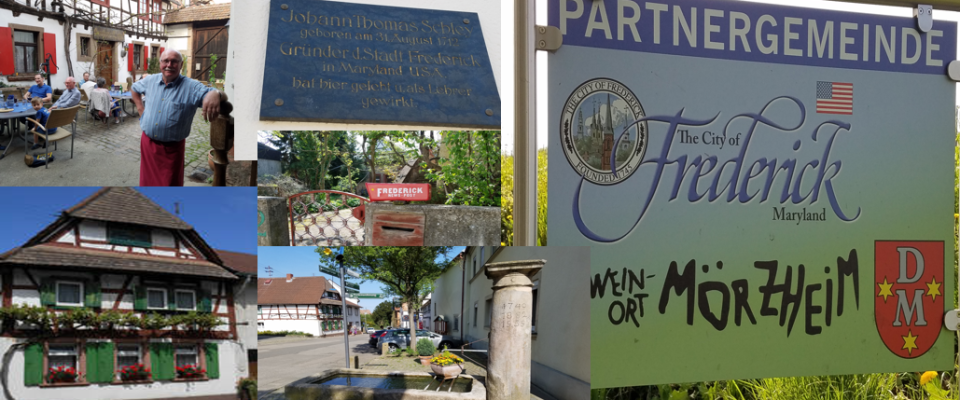
Hans Conrad Heckmann was born Dec. 23, 1724, in the village of Mörzheim in the Rhineland-Palatinate, now a borough of the city of Landau-in-the-Pfalz (see picture above). Mörzheim is one of the two sister cities of Frederick, Maryland, and was also the birthplace of one of Frederick’s first settlers, Thomas Schley.[i]
Hickman family histories suggest that Conrad emigrated to Pennsylvania in 1748, and by 1752 he appears in the records of Frederick County. County Court records indicate that Conrad was indentured to Peter Smith, a blacksmith in Fredericktown. In 1752 he sued for his “freedom dues.” Judgment was issued in favor of the “Poor Servant Man Conrod Hickman” who had served his time but could not get his freedom. The court ordered Smith to pay to Hickman his “freedom dues” and also “a set of smith tools sufficient to Shew a horse”, plus his costs reckoned as 154 pounds of tobacco.[ii]
By 1756, Hickman was able to buy a 92-acre tract of land.[iii] He served in the Frederick County militia in 1757, during the French-Indian War. In 1758, Anna Catharina, daughter of Conrad Hickman and his wife Christina, was baptized at Evangelical Lutheran Church in Frederick. In 1760, Hickman was naturalized as a British subject, having received the required Holy Communion at the Reformed Church in Frederick. Thomas Schley was one of the witnesses testifying that Hickman had received Holy Communion.
To Loudoun County
Hickman probably came to the German Settlement in Loudoun County around 1764-1765. He sold his 92-acre tract of land in Frederick County at the end of 1764, and he first appeared on the Loudoun County Tithable lists in 1765. In 1767, Conrad appeared on a Frederick church record listing those who took Holy Communion “Across the Potomac at Georg Schumacher’s, the Ref. Deac.” Schumacher was a deacon of the German Reformed Church, and the leader of those of the Reformed faith in northern Loudoun County.[iv]
Following the pattern that we documented in our series on the British landowner Lord Tankerville, Hickman had been farming the land here for many years, before he was finally awarded a lease in 1789 after winning a court judgment. The deed document filed in court stated that Conrad Hickman had obtained a judgment in the General Court of Virginia* “for the interest of DeVault Swank[v] and others in a lease of a certain lot of land to contain One hundred acres promised to said DeVault Swank for the sum of three Lives promised by John Patterson former agent to the late Earl of Tankerville [in?] the annual Pmnt [?] of three pounds current money per annum per hundred acres….”
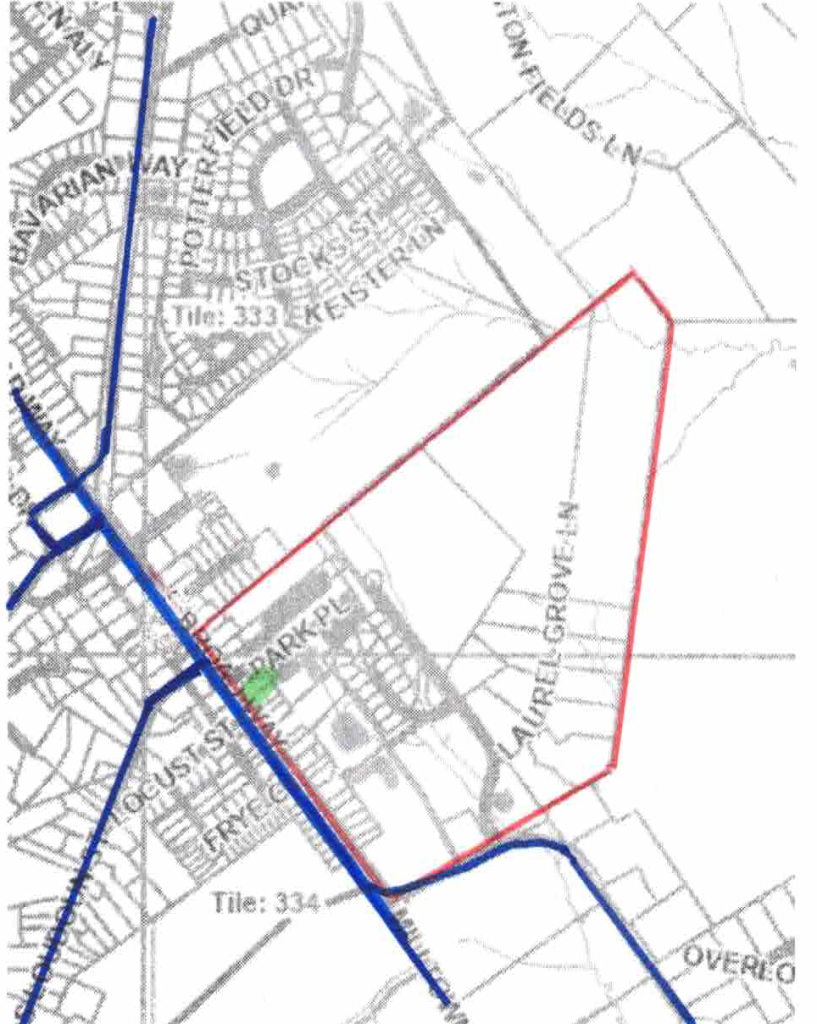
In compliance with the judgment, Henry Astley Bennett Esquire (brother of the Earl of Tankerville), leased to Hickman a lot of land within Catocton Manor “now in the occupation of said Conrad Hickman” beginning at several red oaks and hickorys on a Knowle [knoll] on the road side leading from the Dutch Mill to Roaches [Mill] and is Lot No. 1 in Payne and Summers’s Survey together with all the houses, orchards, etc., containing 103 acres, for and during the natural lives of Conrad aged 62, his wife (now dead aged then 42 years), and his son Peter aged 26 years or the longest liver of them, to pay to Bennett 3 pounds, one shilling and ten pence current money of Virginia. The deed of lease also contained the usual requirement to keep a 26’ x 22’ house, a 24’ v 36’ barn, orchards of apple and peach trees, etc. The deed was executed by Robert Townshend Hooe and Charles Little, as agents for Tankerville, and witnessed by Charles Bennett, George Muir(?), and Adam Shover.[vi]
In 1793, Tankerville sold other lands to Conrad’s sons Peter Hickman and Jacob Hickman, and in 1796 he sold the main 103-acre tract to Conrad Hickman. The deed to Hickman, as usual, recites the history of the Catoctin Tract (and other property in ‘Friedrich County,’ Maryland), from Colville to the Earl of Tankerville, Tankerville’s Will of 1762 giving the property to his son Charles, 4th Earl of Tankerville, etc.[vii]
Conrad Hickman died in 1798, and in 1800-1801, his children conveyed the property to Adam Householder, who also had property on what is today called Householder Road just south of the Town of Lovettsville.
In 1802, Adam Housholder sold the 103-acre tract to George Mann.[viii]
In 1809, George Mann sold the 103 acres to his son John (Johann) Mann. The property’s Metes & Bounds are described as “beginning at a knowle [knoll] on the road from Dutch Mill to Roaches” — the same description as in the 1789 lease to Conrad Hickman.
In 1828, it appears that John and Mary Mann sold the remainder of the tract (now described as 102 acres) to Charles Crook.[ix]
The property remained in the Crook family until 1830, when it was sold at auction to Peter Derry for $1,715. This likely was a result of probate of Charles Crook’s Will. The description of the tract shows that it ran along the main road between the Thrasher property (this tract included Thrasher’s Store, probably located about where the restaurant and the Verizon substation are located today), and the Boger property along Milltown Road starting with the intersection of today’s Lovettsville Road at the Community Center. In other words, this is much of the north side of today’s East Broad Way in the town of Lovettsville, stretching from 15 East Broad (the old movie theatre, now an apartment house and storage facility), to the old school/Community Center property at 57 East Broad.
In 1835, Peter and Eliza Derry sold the large tract (now counted as 105 ¼ acres, perhaps as a result of a re-survey or acquisition), to Ishmael Vanhorne for $2,750. Van Horne also owned property in the town on the south side of the road (today’s East Broad Way).
In 1839, the Van Hornes sold the 105-acre tract to William Graham for $3500. The rapid turnover of these land tracts in the 1830s likely reflects the rapid growth of the area as both the C&O Canal and the B&O Railroad reached Berlin and gave rise to a business boom. It was now much easier for farmers to ship their crops to Baltimore or to Georgetown and Alexandria, and to buy goods shipped from those port cities.
We have now arrived at the point where the ¼ acre lot was split off, which later became known as the Thomas Cost Homestead. In 1841, William and Sarah Graham sold a ¼ acre piece of the larger tract, which fronted on the main street, to Edward Owens for $25. The Grahams apparently built a house on the lot, since four years later, the property sold for $305 to Jesse & Matilda Neer, and is described as a lot and a house. In 1850 the house and lot are sold to Joel Hunt for $330, and in 1858 it sells for $650 to George Werking. Nine years later, in 1867, Thomas Cost buys the property for $700.
As of 1870, there were about eight lots fronting the main street in what had been the Hickman Lot #1. The largest was the furthest east, that of Peter Wire, who gave part of his property to the Lovettsville School District in 1888 to build the first schoolhouse on what later became the Community Center property.
There are more stories to be told, about how Conrad Hickman’s 103-acre land tract was divided up over time, into over 100 separate properties today, ranging in size from .05 acre, to 15 acres or more. We will be looking at some of these stories in the weeks and months to come.
[i] My Ley/Loy and Troud/Trout ancestors, who settled in the Monocacy Settlement in now-Frederick County, were also from this area; the Loys came from Landau, and the Trouts from nearby Impflingen.
[ii] Information from the Hickman Family File, Lovettsville Historical Society.
[iii] There are some indications that this was on the road to Abraham Miller’s mill, which was near Lewistown which is about 6 miles north of Frederick.
[iv] This reference is found in the records of the German Reformed Church in Frederick MD, which is now known as Evangelical Reformed United Church of Christ. In 1760 “Conrad Hekman” is found on the Communion rolls at the church in Frederick.
[v] DeVault Swank was also a German settler. A number of members of the Swank/Schwank family were affiliated with New Jerusalem Lutheran Church. The implication of what we know (which is little) about the lawsuit, is that Hickman was claiming an interest in the land tract of the then-deceased Swank, who had never been able to obtain a lease from Tankerville.
[vi] Loudoun County Deed Book R 262.
[vii] Loudoun County Deed Book X 200.
[viii] George Mann also had won a judgment in 1789 against Tankerville for an award of a lease on another tract, which Mann was able to purchase in 1796 – the same pattern as with Conrad Hickman. Loudoun County Deed Book R 437.
[ix] In 1823, John Mann and his wife Mary had sold one acre of the larger tract to one Harvey Cogsill.