
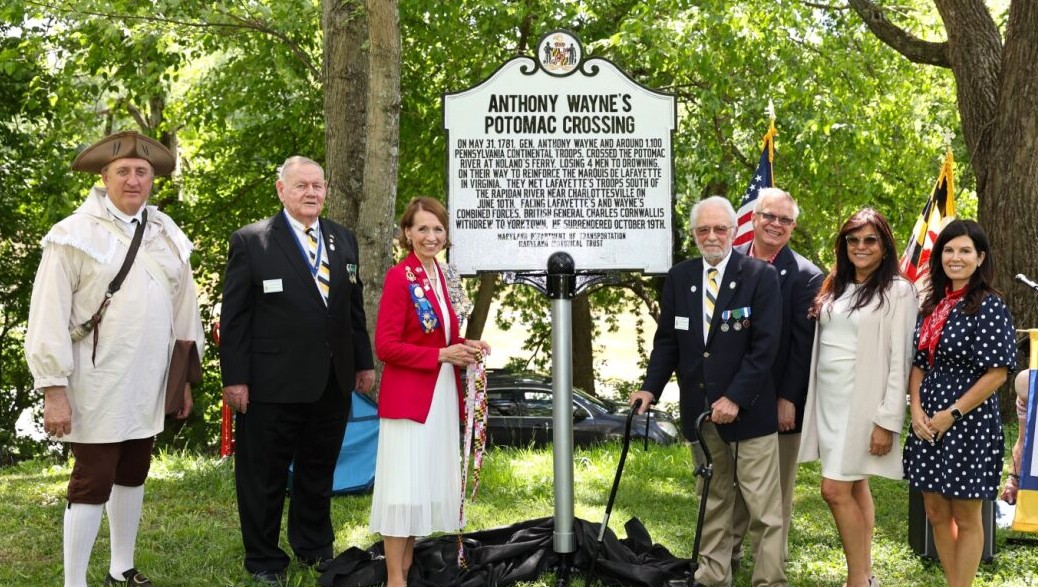
Frederick County 250 Commission; and Julie Schablitsky, Maryland Department of Transportation.
By: Edward Spannaus
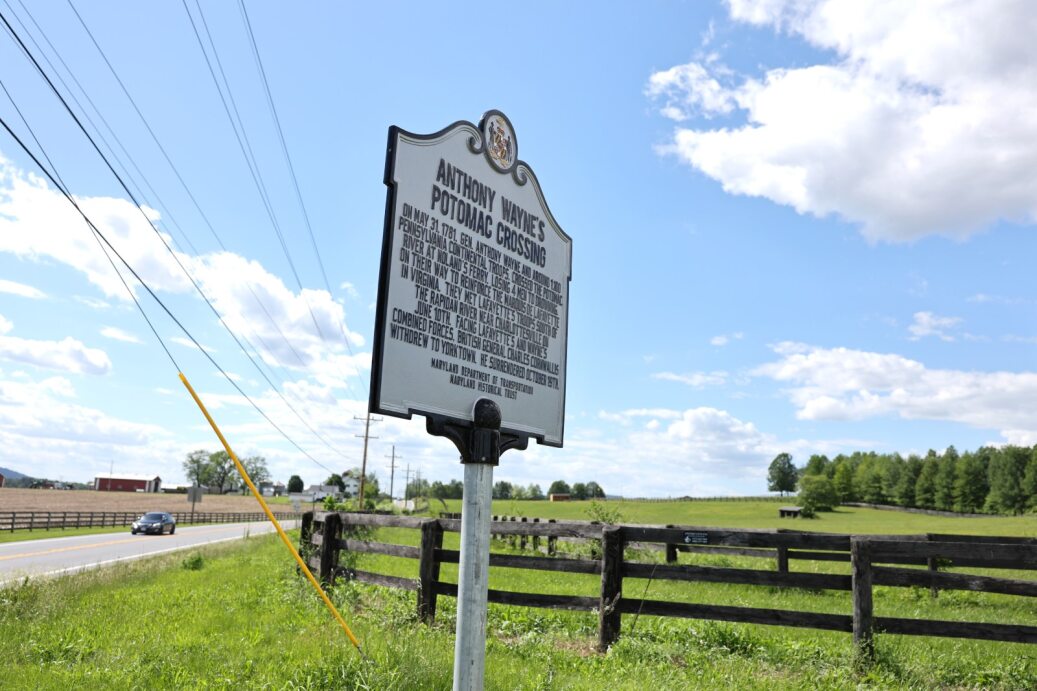
245 years ago, General Anthony Wayne and 1000 Pennsylvania Continental troops crossed the Potomac River at Noland’s Ferry, losing men, horses, and ammunition to the turbulent river waters.
On May 28, 2026, an historical marker commemorating Wayne’s Crossing was dedicated on the Maryland side of Noland’s Ferry, co-sponsored by the Maryland Department of Transportation and the Sgt. Lawrence Everhart Chapter of the Sons of the American Revolution (SAR). (This is the third historic marker installed over the past two years by the SAR in Frederick and Carroll Counties;[i] additionally, the “Wayne’s Crossing” marker at Lucketts in Loudoun County was updated and rededicated a year ago at the initiative of the SAR in Virginia.)
During the May 28 dedication ceremony at Noland’s Ferry, the question was raised: Why did Wayne change his plans and cross the Potomac here, and why did he attempt the crossing in such bad weather?
Here’s some of what we know.
In February of 1781, George Washington ordered the Marquis de Lafayette to take 1200 Light Infantry troops to Virginia, to strengthen the small number of Continentals under Von Steuben which were already in Virginia.
Virginia had been invaded by British forces under the command of turncoat Benedict Arnold at the end of December 1780. Facing no resistance, Arnold had captured Richmond by January 5, and launched a campaign of destruction in central Virginia, looting and destroying anything that might be of value to the American forces.
Lafayette’s forces were no match for the British, even less so after Cornwallis brought over 5000 more British and Hessian troops into Virginia in May.
Meanwhile, Wayne was facing formidable obstacles in recruiting, retaining, and equipping sufficient Pennsylvania Continentals to make the march to Virginia to aid Lafayette. The troops had mutinied in January over lack of pay, terms of enlistment had expired, and “war fatigue” and lack of funds made supplying the troops a challenge.
From April 1781 on, Washington and the Board of War were urging Wayne to get moving as quickly as possible, as was Lafayette. On May 15, just after Cornwallis and his 5300 men had arrived in Petersburg to the British troops already there, Lafayette wrote to Wayne from Richmond:
Where this letter will meet you, I am not able to ascertain, But ardently wish it may be near this place where your presence is absolutely necessary.
Two days before this, the Board of War in Philadelphia had again pleaded with Wayne to start moving, citing communications received from Lafayette and Virginia Governor Thomas Jefferson, and warning that “the worst of consequences” were likely unless Lafayette’s forces were augmented by Wayne. “The Board are of the opinion that it would be best to push on the Infantry in the first instance by forced Marches and leave the baggage and heavy stores to follow after.” They told Wayne that they trusted that he would take such measures “as will be most likely to effect a junction with the Marquis in the shortest space of time the nature of the case will admit of.”
It wasn’t until May 26 that Wayne was able to leave York, Pennsylvania – slowed by another mutiny and lack of supplies – and immediately he was plagued with bad weather which slowed his march. On May 28, they passed through Taneytown, Maryland and encamped at Bruce’s Mill, after crossing Big Pipe Creek. On the 29th, despite high water too deep to wade through, Wayne gambled that they could make the crossing in horse-drawn wagons ferrying men and supplies across the Monocacy River north of Fredericktown. The horses stumbled on the rocky river bottom, spilling their cargo into the river.
As a consequence, the time that Wayne had hoped to gain was lost, as his officers and men had to spend two nights in the encampment just north of Fredericktown to dry out and clean their uniforms and weapons.
A change of plans
By the morning of May 31, when Wayne’s forces broke camp and continued their march south, Wayne had changed his planned route.
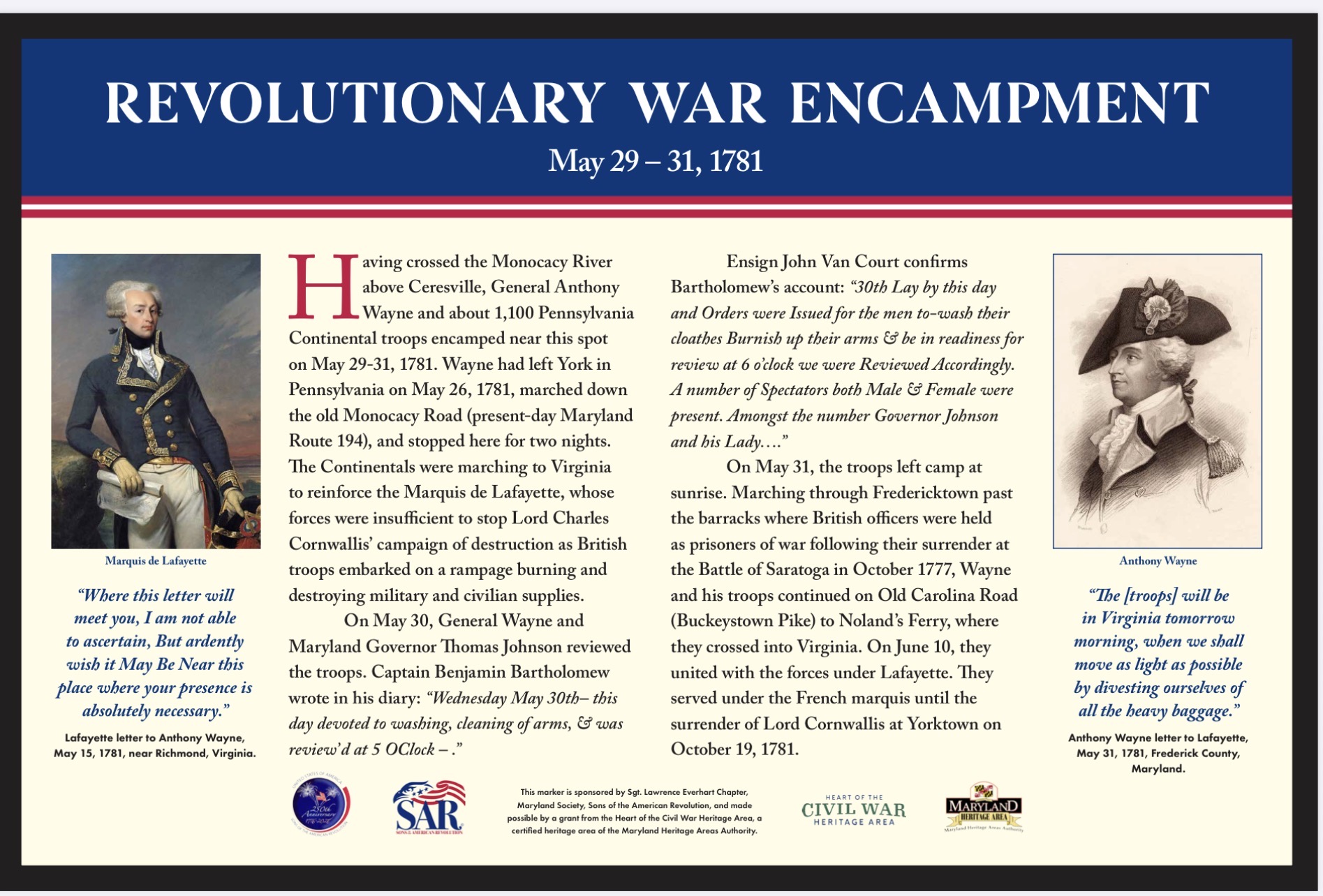
The original plan had been to march to Georgetown, where supplies and boats were waiting for him. But the General was under heavy pressure to make haste. He was receiving letters almost daily from Lafayette, who was anxiously watching Cornwallis’s advances, while avoiding a head-on confrontation with the superior British forces. We know that communications from Lafayette reached Wayne in Maryland on May 27, 28, and 29th.
And we know of at least three letters sent by Wayne to Lafayette on May 31 and early on the morning of June 1 – while preparing his Potomac Crossing, and soon after completing that arduous undertaking:
(1) On the morning of May 31, while still in Fredericktown, Wayne wrote to Lafayette, acknowledging receipt of Lafayette’s letters of May 27 and 28, and informing Lafayette of his progress and his probable route. Wayne gave the strength of his detachment as “1000 Combatants exclusive of Artillery, which consists of 9 Officers 90 Non Commissioned Officers and mattrosses [assistants to the artillery gunners] with Six field pieces.”
(2) On the evening of May 31, Wayne wrote to Lafayette:
Yours … came to hand as the troops were passing the Potowmack. The whole will be in Virginia tomorrow morning, when we shall move as light as possible by divesting ourselves of all the heavy baggage. I am fully of the Opinion with you that Fredericksburg is one of the Enemies Objects—perhaps Alexandria an Other, to attain which the defeat of your army must have been a desirable event, as it would Insure them a safe & peaceable possession of a great proportion of this state.
I have this morning mentioned the route we intend to take, i.e. thro’ Leesburg, at which place we shall be tomorrow evening & from thence in the most direct course for Fredericksburg, unless the Maneouvres of Lord Cornwallis should render an other Direction more advisable. In that case your Opinion[s] will govern your most Obt. & since Hum. Sert. Anty. Wayne
(3) On the morning of June 1st, Wayne penned another letter to Lafayette from the Virginia side of what he called “Nowlan’s Ferry,” stating:
My Dear Marquis
I wrote by express from Fredericktown yesterday morning & again at 9 O’Clock last Evening acknowledging the rect. of yours of 27th, 28th, & 29th ultimo.
We shall reach Leeburg this Evening, which is performing a march of thirty Miles in two days, besides passing the troops Artillery & baggage over the Potomack, in four Little boats, one of which sunk – lost some Amunition & a few men Drowned. The excessive wet Night was much against us—however every fatigue & Difficulty is surmounted by Our anxiety for the wished for Junction. If my intelligence is right we probably may meet between Leesburg an Fredricksburg. Interim I have the Honor to be your most Obt. Hune. Sert. Anty. Wayne [emphasis added]
In fact, Wayne had lost four or five men who drowned during the crossing, two horses, and ammunition and artillery pieces which spilled into the river. The crossing, expected to take two or three hours, took over eight hours due to the high, turbulent waters and having to make their way to the Virginia side in four flatbed boats (scows) which were ill-suited to being loaded down with equipment and men in rapid waters.
Why Noland’s Ferry?
We have seen that Wayne decided not to take the Georgetown route to Virginia, because of the urgency to coming to Lafayette’s aid as quickly as possible – and also because he didn’t want to walk right into Cornwallis’s path should the British commander march north to Fredericksburg and even to Alexandria.
Once having made the decision not to march to Georgetown, Noland’s Ferry was the obvious choice for the Potomac Crossing. There were many other ferries linking Maryland and Virginia along the Potomac, but Noland’s Ferry was part of the primary north-south route at the time, which was known as the Carolina Road.[ii] (It was also called the “Upper Road” or the “High Road.”) There was no continuous coastal route at the time, the “King’s Highway” or the Post Road being cut off by wide rivers and bays as they got flow into the Atlantic.
Travelers between Virginia and the South, going to Philadelphia, generally travelled along the Carolina Road to Frederick, Maryland, and then took the “Monocacy Road” and the “Wagon Road” to York, Lancaster, and Philadelphia. George Washington and Thomas Jefferson were among the notables who crossed at Noland’s Ferry.
And thousands of British and German “Hessian” auxiliary troops, after surrendering at Trenton in 1776, Saratoga in 1777, or Yorktown in 1781, crossed at Noland’s Ferry on their way to prison camps in the interior.
The road to Yorktown
Remember, Anthony Wayne had assured Lafayette that he and his troops would be in Leesburg by the evening of June 1. Instead, they didn’t reach Leesburg until June 3, slowed by having to fish their artillery field pieces out of the Potomac, and again trying to dry out men, uniforms, and equipment. When they finally got started again, they were slowed by torrential rains and thunderstorms, which continued through the night and the next day.
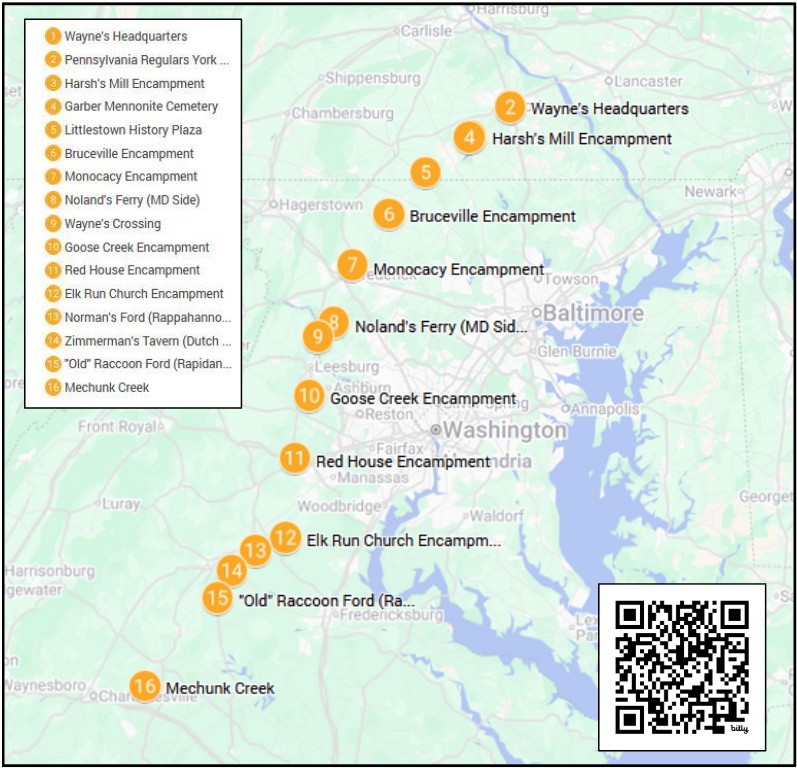
After passing through Leesburg – a town with which the Pennsylvanians were not impressed (one officer declared himself “disappointed in” its appearance) — they encamped at Cox’s Mill on Goose Creek (near what later became known as Evergreen Mills).
Finally, on June 10, Wayne’s troops and Lafayette’s troops met up north of Charlottesville. Shortly thereafter, Cornwallis determined to halt his advance in the Virginia Piedmont, and turned around and headed back to his supply base on the Chesapeake, ending up at the York River, where the siege by American and French forces forced him to surrender his army on October 19, 1781.
Since today we know how it turned out, Wayne’s march is often viewed as part of the Yorktown Campaign. But Wayne and his troops had no idea of this, on their hurried and fraught march to join forces with Lafayette in May and June.
At the time when Wayne was preparing to leave Pennsylvania for Virginia, Washington and his French allies had not yet decided where they would confront the British.
Indeed, on May 31, the very day of Wayne’s Potomac crossing, Washington wrote to Lafayette that an attack on British-held New York was preferable to an operation in the South and Virginia. This was very disappointing to Lafayette, who was operating in Virginia, although Lafayette knew that his presence in Virginia, however precarious, was important to draw British resources away from New York, were a French-American offensive to take place there.
The French fleet and troops had arrived at Rhode Island in July of 1780, but it wasn’t until May 1781 that Washington and the French troop commander, the Comte de Rochambeau, agreed to join forces for a possible attack on New York. By late July, after a series of probes, Washington believed that the combined American and French forces weren’t strong enough to attack the British in New York. Then on August 14, Washington learned that the French naval commander Admiral de Grasse was sailing to the Chesapeake — not to New York — with the objective of capturing Cornwallis’s army. Washington and Rochambeau immediately agreed to march their armies to Yorktown, and the die was cast. Washington also instructed Lafayette and Wayne that they should block any attempt by Cornwallis to escape to North Carolina.
Washington and Rochambeau, then in White Plains, New York, set off for Yorktown, with some of the troops travelling down the Chesapeake Bay by water, but most by land. On September 22, Washington’s and Rochambeau’s forces linked up with Lafayette’s and Wayne’s troops. The siege of Yorktown soon commenced, and Cornwallis surrendered on October 19.
Wayne’s Pennsylvanians and their march though Frederick and Loudoun Counties had played a far more important role than they had ever anticipated. Their presence turned the tide of the war in Virginia, and set into motion the chain of events that culminated in the French-American victory.
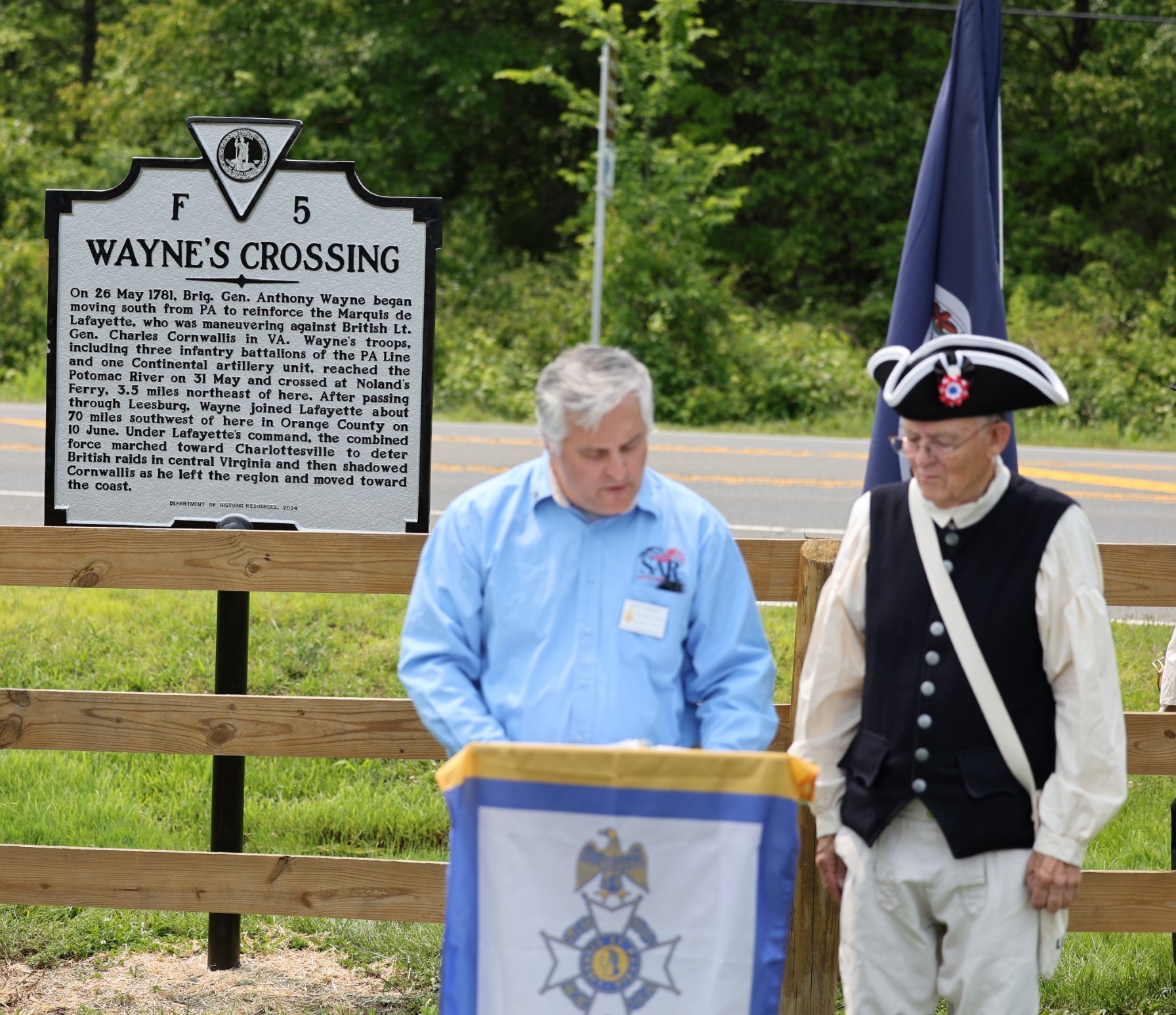
[i] The first marker in western Maryland, along MD Route 194 at Big Pipe Creek south of Taneytown, was dedicated on May 28, 2024. The second was dedicated near the site of Wayne’s Monocacy encampment, at Riverside Park in north Frederick on Dec. 6, 2025. A fourth historic marker is planned at the Hessian Barracks in Frederick. At the time of Wayne’s march, British officers who had surrendered at Saratoga were housed there, and many watched as Wayne’s Continentals marched past.
[ii] As recently as the 1920s, U.S. Route 15 (then following the Buckeystown Pike from Frederick), crossed the Potomac at Noland’s Ferry, before continuing on to Leesburg and points south.