
By Edward Spannaus
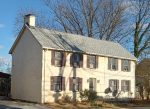
Over the summer, rumors were flying around town that the house at 25 East Broad Way – one of Lovettsville’s earliest brick homes – was about to be sold and demolished. Although those rumors have died down, and we are informed that investors who bought the house plan to renovate it, we may find it worthwhile to take a look at the history of this property, in hopes of encouraging its preservation.
This house, and the other adjacent brick houses at 21 and 23 East Broad Way, and those directly across the street at 30 and 32 East Broad Way, are singled out in the 2011 Historic District Survey, which was the basis for Lovettsville’s nomination to be placed on the National Register of Historic Places.
The survey notes that the town’s earliest buildings date to the 1820s, when the town was laid out by David Lovett, but that a number of brick dwellings date back “to the early years of Lovettsville’s settlement.” The cluster of brick buildings on East Broad Way are estimated to date from the 1830s and the 1850s in the survey. Although the latter date (ca. 1850) is given for the Thomas Cost House, our more detailed research indicates that it was built in 1841-42, when the property was owned by Edward Owens.
The owners of this property, from the time it was split off as a quarter-acre lot from the larger tract originally known as Tankerville Lot #1 (more on this in our next issue), were:
1841 – Edward Owens
1845 – Jesse & Matilda Neer
1850 – Joel Hunt
1858 – George and Catharine Werking
1867 – Thomas J. Cost, and daughter Irma Cost after father’s death in 1911
1921 – Walter W. James
1966 – Dorothy Rollins
1980 – Aurlino & Corazon Arellano
2025 – Infiniti Marketing & Investment
For recent decades, when the Arellano family lived there, the house was known for its perfectly-curated roses in the front, Filipino and other vegetables grown in back (and watered from a system of rain barrels), and its chickens – including one sometimes known as “that damned rooster” for its cocka-doodle-doo at 5:00 or 6:00 o’clock in the morning. The rooster isn’t missed, but the rest is.
But going back in years, in the latter part of the 19th century and the early 20th century, this property was known as the “Thomas J. Cost Homestead,” according to a 1921 deed.[1]
Who was Thomas Cost?
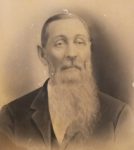
Thomas Jackson Cost[2] (1833-1911) was a prominent and well-respected Lovettsville merchant and civic leader in the decades following the Civil War. During the Civil War, Cost was a well-known Unionist, and in January 1864, he was selected as one of three election commissioners for a special election for the Virginia Unionist government. Reportedly, several hundred Unionists turned out to elect Loudoun delegates to the Unionist constitutional convention held in Alexandria in February 1864.[3] (Thomas’s brother William F. Cost was a volunteer in the Union Army, in a unit which guarded President Lincoln.[4])
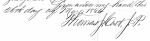
At the war’s end, Thomas Cost was elected as a local Justice of the Peace. (See his signature as a “J.P.” in 1866, at right.)
In 1866, Cost was also a charter member of the local Masonic lodge, Freedom Lodge No. 199, and served as a Trustee.
By 1869, Cost had a mercantile business in Lovettsville, advertising “Cheap Goods,” boasting of the cheapest goods in the county. “Come right along with your Greenbacks or produce,” the advertisements urged. His most durable partnership in the mercantile business seems to have been John H. Yakey, who was also a neighbor and related by marriage. (See newspaper ads below).
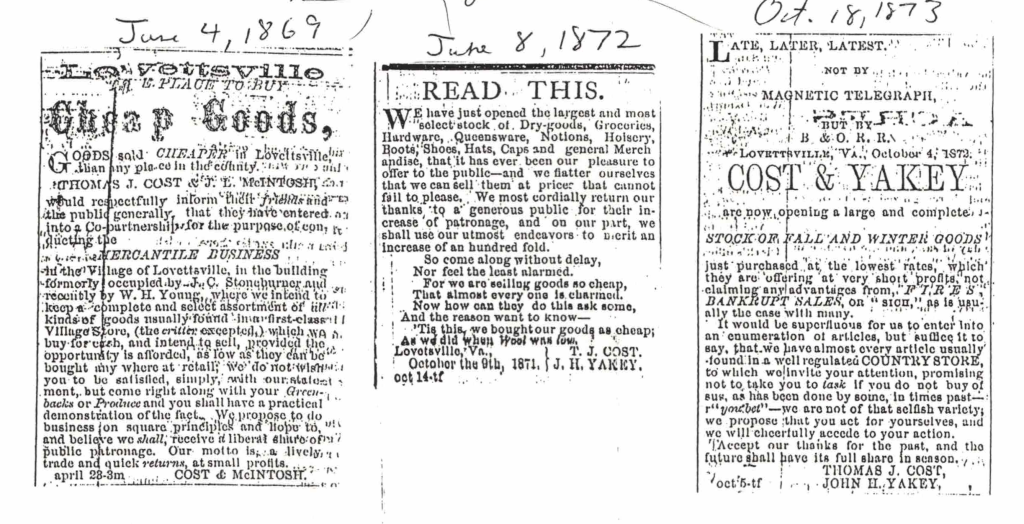
The Cost family — Thomas, and later his sons Eugene and Grafton — were merchants in Lovettsville up into the 1930s. Some accounts say that the store later known as McClain’s, was once operated by the Cost family.
The Costs, and Thomas in particular, were affiliated with German Reformed Church, known after 1901 as St. James Reformed (and more recently as the St. James United Church of Christ). At the time of the move into town and the dedication of the new building in 1902, Cost was an Elder of the church, along with his business partner John Yakey, and fellow storekeeper George Eamich. Around this time Thomas Cost transcribed the old records of the Reformed Church which, he stated, had been “carelessly kept.”[5]
Family background
Thomas’s parents were Jonathan Cost (1793-1846) and Margaret Nichols Cost (1802-1877). Jonathan Cost was born in 1793 in the German Settlement (later Lovettsville). In 1822, he bought a house and lot (known later as the “Lloyd Curtis House”) in Waterford. Jonathan was elected one of Waterford’s first Commissioners when it was incorporated as a town in March 1836.
In 1832, Jonathan Cost married Margaret Nichols, whose family background was English, not German. Thomas was born the next year.
Jonathan Cost was the son of Barbara Kast and Johann Dorschheimer (Thomas’s grandparents), who at the time were young people and members of the German Reformed Church. (They were not married, and Jonathan was given his mother’s surname.[6]) Barbara was born Jan. 8, 1773, the daughter of Frantz and Catharina Kast; her baptism appears in the records of the Reformed Church in Frederick kept by Rev. Henop, who also served the Reformed congregation in what is now Lovettsville.
Both the Kast and Dorschheimer families were German in origin; many Kasts are found in the Lutheran and German Reformed Churches in Frederick County, Maryland, and in Pennsylvania; Dorschheimers are found among the Pennsylvania Germans, but only a few times in Frederick County.
Coming back to Thomas, he and Jane Amelia Yakey[7] were married in September 1860. A wedding notice reported: “At the residence of Andrew Seitz, Esq., near Hoysville, Loudoun County on Wednesday evening the 26th ult., by the Rev. George W. Morris [Martin?], Mr. THOS. J. COST, of Wheatland, to Miss JANE AMELIA YAKEY, only daughter of the late Martin Yakey.”[8]
They had 14 children. Jane died in 1892, and Thomas in 1911. Both are buried at the St. James Reformed Cemetery in Lovettsville.
(In Part II of this article, we will look at the history of this property from colonial times up to the 1840s.
Thanks to Lori Kimball for research assistance.)
[1] Deed 9M:252, Irma M. Cost to Walter W. James, 2 May 1921.
[2][2] Some sources, such as Find-a-Grave, give his middle name as Jonathan, but a transcription of the family Bible says “Jackson.” Source: Cost Family File, Lovettsville Museum.
[3] Taylor M. Chamberlin and John M. Souders, Between Reb and Yank, p. 227. Cost was also named as a potential witness for Union spy Charles W. Johnson, referenced here.
[4] William Flavius Cost (1837-1881) enlisted in the D.C. Volunteer Infantry in early 1862, and when his term of enlistment was up, he joined the 11th N.Y. Cavalry, which was assigned at that time to the defenses of Washington. In both the D.C. Regiment and Co. K of the 11th N.Y., William Cost was involved in providing protection to President Lincoln, especially as he travelled from the Soldiers’ Home to the capital. Source: “”William F. Cost,” N.Y. Department of Military and Naval Affairs.
[5] Yetive Weatherly, Lovettsville: the German Settlement, pp. 87-88.
[6] According to the church records, Barbara Kast confessed to the church Elders that the father of the baby was Johann Dorschheimer. After Barbara had “recognized the sin,” the baby Jonathan was baptized on March 2, 1794, with members of the Dorschheimer family as sponsors. Johannes Dorschheimer had been confirmed and received first communion in 1790, in the same class as Barbara Kast. (Source: St. James Church Register, 1789-1823.) Barbara Kast/Cost married church member Simon Yaky in 1807; the Jaecke/Yaky/Yakey family was closely associated with Thomas Cost and were neighbors. Thomas’s business partner was a John Yakey. It is not known who raised young Jonathan.
[7] Some sources, such as the family Bible, give her middle name as America.
[8] Virginia Free Press, October 11, 1860, posted on Find-a-Grave. For more on the Seitz family, see here.